Practice News
Changes to childhood vaccination schedule from January 2026
Childhood vaccination changes 2026
From January 2026, there will be some changes to the childhood vaccination schedule.
These updates have been introduced to give children earlier and broader protection against serious illnesses. The revised schedule ensures vaccinations are offered at the most effective times to help protect children as early as possible.
Your GP practice will contact you when your child or children are due to receive their vaccinations. However, if you believe your child is due a vaccination and you have not yet been contacted, you can speak to your GP practice directly to arrange an appointment.
Routine childhood vaccinations provide children with protection against a range of diseases that can be very serious.
Why is this change happening?
The NHS childhood vaccination schedule has recently been updated to help give children even better protection against diseases. Changes include protecting children against some diseases earlier and adding vaccines that protect against more diseases.
What action do I have to take as a parent/carer?
You’ll usually be contacted by your GP practice when your child is due for their next routine vaccination appointment. This could be via a letter, text, phone call, or email.
If you know your child is due for a vaccination and you have not been contacted, you can speak to your GP practice to book the appointment.
What are the changes?
MMRV vaccine replaces the MMR vaccine
From 1 January 2026, the MMRV vaccine will be introduced into the routine childhood immunisation schedule in the UK. The MMRV vaccine protects against 4 serious diseases: measles, mumps, rubella, and chickenpox (known as varicella). The MMRV vaccine has been safely used for over a decade and is already part of the routine childhood vaccination schedule in several countries, including Canada, Australia and Germany.
When your child will be offered the MMRV vaccine will depend on their date of birth. Children born on or after 1 September 2022 will be offered 1 or 2 doses of the MMRV vaccine as part of their routine vaccinations. A single MMRV catch-up dose will be offered to children born between 1 January 2020 and 31 August 2022 if they haven’t already had chickenpox or been vaccinated against it. This dose will be offered between November 2026 and March 2028. More detail on the eligibility can be found in our blog post: what is the MMRV vaccine and is my child eligible?
Changes to the 1-year appointment
The Hib/MenC vaccine will no longer be offered at the routine 1-year vaccine appointment. This is because the adolescent MenACWY programme has resulted in a significant reduction in cases of meningococcal infections, so the Joint Committee on Vaccination and Immunisation (JCVI, a group of experts) no longer recommends a dose of a MenC-containing vaccine for infants.
The JCVI now instead recommends an extra dose of the 6-in-1 vaccine, which gives protection against Haemophilus influenzae type b (Hib), which will be offered at the 1-year or 18-month appointment, depending on your child’s date of birth. This will help to prevent the spread of Hib in the community and maintain herd immunity. It offers protection against diphtheria, tetanus, whooping cough, polio, Hib and hepatitis B.
For children born on or after 1 July 2024, a fourth dose of the 6-in-1 vaccine will be offered at 18 months. Children born before 1 July 2024 who have not yet had their 12 month vaccines may be offered a booster dose of either Hib/MenC, or the 6-in-1 vaccine.
Introduction of an 18-month appointment
For children born on or after 1 July 2024, a new 18-month appointment will be introduced. At this appointment, a fourth dose of the 6-in-1 vaccine will be offered at 18 months rather than 12 months.
The new 18-month appointment also provides an opportunity for the second dose of the MMRV vaccine to be given earlier, moving forwards from the 3 years 4 months appointment to the 18-month appointment. This will help provide children with protection against measles, mumps, rubella, and chickenpox from a younger age, reducing the likelihood of outbreaks and helping to increase uptake of the vaccine.
Second dose of the Meningococcal B (MenB) vaccine offered earlier
The second dose of the meningococcal B (MenB) vaccination, previously offered at 16 weeks of age, was moved to 12 weeks from 1 July 2025. (The first dose is offered at 8 weeks).
MenB can cause serious illnesses, including meningitis and sepsis. Moving the second dose to 12 weeks helps to provide greater protection, earlier. This is particularly important as, since the vaccine was introduced in 2015, there have been increasing number of cases of meningitis B in young babies who had not yet gained the protection from the second dose of the vaccine. JCVI advised that it would be beneficial to move the second dose of MenB vaccine to 12 weeks of age to provide earlier protection.
Pneumococcal vaccine offered later: The first dose of the pneumococcal vaccine moved from 12 weeks to 16 weeks of age
The first dose of the pneumococcal vaccine, previously offered at 12 weeks, will now be offered at 16 weeks, so that the MenB vaccine can be given earlier. This was introduced from 1 July 2025. Although your baby will get the pneumococcal vaccine 4 weeks later than previously, they will still be protected. This is because pneumococcal disease is now very rare in young babies, due to high vaccination rates in the wider community, which provides herd immunity.
Where can I find more information?
These updates to the childhood vaccination help to provide children with the best possible protection against serious diseases.
Visit the following links below for more information:
- MMRV vaccination: a guide for parents and carers
- Immunisations: babies up to 13 months of age
- Immunisations at one year of age
- Vaccinations for children aged 18 months
- Pre-school vaccinations: guide to vaccinations from 2 to 5 years
Antimicrobial resistance awareness
Raising awareness of antimicrobial resistance (AMR)

On Monday 7 April, the UK Health Security Agency will be launching a new pilot campaign focused on antimicrobial resistance (AMR). This will be the first public awareness initiative in England since 2017 and it aims to re-engage younger adults with AMR and build support for the behaviours that will help keep antibiotics working.
3 Key Messages
The campaign focuses around 3 key messages:
- Do not take antibiotics for colds and flu
- Do not save antibiotics for later
- Take antibiotics as directed by your healthcare professional
Do not take antibiotics for colds and flu
You should not take antibiotics for the flu or a cold because they are caused by viruses, and antibiotics are only effective against bacterial infections, not viral ones.
Do not save antibiotics for later
You shouldn't save leftover antibiotics for later because doing so can contribute to antibiotic resistance, potentially making future infections harder to treat, and may not be the correct antibiotic or dose for a new illness.
Take antibiotics as directed by your healthcare professional
As directed and prescribed by your healthcare professional, you need to take the full treatment to kill the disease-causing bacteria. If you don't take an antibiotic as prescribed, you may need to start treatment again later. If you stop taking it, it can also promote the spread of antibiotic-resistant properties among harmful bacteria.
Always consult your healthcare professional first for advice regarding the responsible way to take antibiotics safely. This will benefit both you and your family into the future.

Our PCN Mental Health Practitioner
Our PCN Mental Health Practitioner
East Basildon PCN provides children and young people with a mental health practitioner to support them in a variety of ways.
We currently have a mental health practitioner who will be available to children and young adults throughout our PCN, and her name is Precious Akenzua.

Precious is here to provide mental health support by offering:
- Pyschoeducation, advice and signposting to other services.
- Specialist mental health consultation and advice for primary care colleagues.
- Assessment for young people up to 18 who might require further exploration to understand their mental health needs.
- Low-intensity, evidence based interventions for problems such as low mood, mild to moderate emotional difficulties, anxiety, stress related issues and sleep difficulties.
Visit our East Basildon PCN website and click here to learn more about Precious and her role as a Mental Health Practitioner for our PCN.
Dementia Survey
Dementia Survey
Dementia Survey by Thurrock Council
Click here to take the Dementia Survey today.
Healthwatch Thurrock are the independent champion for people who use Health and Social Care services in Thurrock. Our sole purpose is to understand the needs, experiences and concerns of people who use Health and Social Care services and to speak out on their behalf. We work to get services right for the future. We are here to listen to what you like about services and what you think could be improved. You can also speak to us to find information about health and social care services available locally.
About the project: Lived experience of dementia Healthwatch Thurrock want to engage with local residents to ensure the voices of those living with dementia are being full captured. We are also interested to hearing from carers, family members and professionals so we can paint an in-depth picture of the current support for dementia in Thurrock to review what is working well and what could be improved.
If you’d like to go one step further than completing this survey then we’d love you to get in touch. Whether you’d like to speak to us in person over a cuppa, take part in a focus group with your peers or have call with us, just let us know. We would love to hear from you to ensure Thurrock is truly a dementia friendly community. Please share the invitation with anyone you feel this may be relevant to.
Dry January
The benefits of Dry January
Felmores Medical Centre promotes Dry January, which is a popular trend in the UK that involves abstaining from alcohol for the entire month.
Recent research has shown that this month of alcohol-free abstinence can have significant benefits for both physical and mental health. In this blog post, we will explore the advantages of participating in Dry January and provide strategies for successfully completing the challenge.
Improved physical health
When it comes to our overall health, reducing alcohol consumption can have a significant impact. Studies have shown that a month of alcohol-free abstinence, such as participating in Dry January, can lead to various improvements in physical health.
Examples of physical health improvements are:
-
Improved insulin resistance
-
Weight loss and blood pressure reduction
-
Reduced risk of heart and liver disease
-
Lower risk of various types of cancer
Enhanced mental well-being
Taking a break from alcohol can have several positive effects on mental well-being. Many individuals who have chosen to abstain from alcohol for a period of time have reported experiencing improved mental clarity and an overall uplift in mood.
One of the key ways in which alcohol-free periods can benefit mental well-being is by helping to reduce feelings of anxiety and depression. Excessive alcohol consumption has been known to exacerbate these conditions, and by abstaining from alcohol, individuals can give their mental health a much-needed break.
Financial benefits
Participating in Dry January can have numerous financial benefits. One of the most obvious advantages is the amount of money that can be saved by abstaining from alcohol for a month. Alcohol can be expensive, especially when consumed regularly or in large quantities. By refraining from drinking during this month, individuals can save a significant amount of money that would have otherwise been spent on alcohol.
Imagine the extra cash you can have in your pocket by the end of the month. The money saved from not purchasing alcoholic beverages can be used for a variety of other purposes. For example, you can treat yourself to a special experience that you’ve been wanting to try for a while. Whether it’s a fancy dinner at a restaurant, a spa day, or tickets to a concert, the saved money can be put towards creating memorable moments and enjoying life to the fullest.
To learn more about Dry January, click here to visit the East Basildon PCN website.
Blood pressure measurement
Accurate blood pressure measurement is crucial for managing cardiovascular health. This blog post explores the benefits of managing blood pressure more aggressively, the challenges with current measurement methods, and the potential for continuous monitoring devices.
The importance of monitoring your blood pressure
A blood pressure test checks if your blood pressure is healthy, or if it’s high or low. Blood pressure is the term used to describe the strength with which your blood pushes on the sides of your arteries as it’s pumped around your body. The medical term for high blood pressure is hypertension, which means your blood pressure is too high and your heart is working harder when pumping blood around your body.
Checking your blood pressure regularly and sharing the results with your GP practice can help your GP to understand your blood pressure. Your GP can then offer you advice and support to avoid serious problems, such as heart attacks, strokes and other health conditions.
Why you would be chosen to check your blood pressure
Our local GP Practice or a clinical staff member would have identified you as someone they would like to monitor their blood pressure at home. This may be because you:
- previously had a high blood pressure reading
- may have a health condition that puts you at risk of high
blood pressure - may have already been diagnosed with hypertension.
What is normal blood pressure?
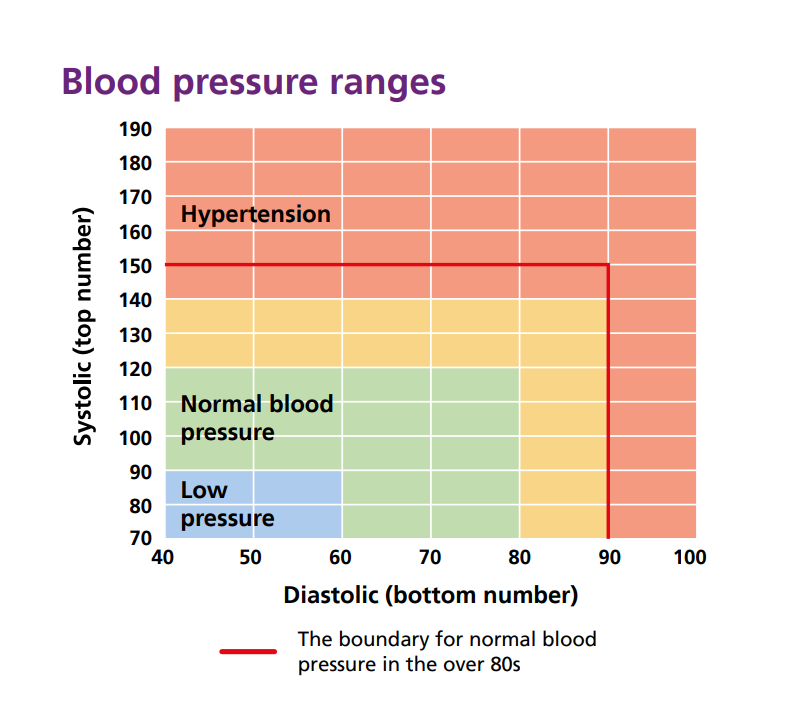
Normal blood pressure is usually considered to be between 90/60 mmHg and 120/80 mmHg. For the over 80s, because it’s normal for arteries to get stiffer as we get older, the ideal blood pressure is under 150/90 mmHg (or 145/85 mmHg at home).
High-normal blood pressure is when you don’t have an ideal blood pressure, but you also don’t have hypertension. Being at this level might prompt you to explore ways to reduce your blood pressure to avoid developing high blood pressure in the future. Being at this level might prompt you to live a healthier lifestyle so you don’t develop high blood pressure.
How to monitor your blood pressure
It’s really important to monitor your blood pressure correctly, as this could impact your readings.
- Sit in comfortable position with your legs uncrossed and your back supported.
- Place the cuff 2-3cm above the elbow. Place it directly on the skin if possible.
- The cuff’s tubing should be at the centre of your arm on the front side.
- Your forearm should be supported at heart level.
- Take a reading. Take a second reading after a few minutes as the first is often high.
- Note and send your readings to your GP practice at the end of the four days.
Watch our instructive video below and find other helpful resources to manage your blood pressure.
Alternatively you can ask your GP for more information.
East Basildon PCN
If you would like to know more about Blood Pressure Measurement, click this link to the East Basildon PCN website to learn more today.
Opportunistic Health Check Event 2024
East Basildon PCN hosts opportunistic health check event
The Integrated Neighbourhood Team of East Basildon PCN will be putting on an event that provides an opportunistic health check for all of our patients within East Basildon on Wednesday, the 24th of January 2024.
Take the opportunity to get a free health check to reduce any future healthcare risks.
Our Primary Care Network staff will be on site to assist you and discuss any general concerns you may have about your health.
Purpose of the event
The purpose of the event is to support the health and wellbeing of the community by offering free healthcare consultations that will provide the following checks:
- blood pressure (BP)
- blood glucose (BM)
- body mass index (BMI)
- cholesterol
This can allow for someone receiving the consultation to determine if they should be referred to their local GP practice if there are health concerns such as:
- diabetes
- high blood pressure (hypertension)
- low blood pressure (hypotension)
- kidney disease
GP practices involved
The GP practices included in the Primary Care Network of East Basildon are:
- Felmores Medical Centre
- Long Riding Surgery
- Aryan Medical Centre
- Hoover Drive Branch Surgery
- Matching Green Surgery
- Dr Sims & Partners
Event information
The opportunistic health check event will be held at:
Location: The Place, Pitsea Leisure Centre
Address: 13 Northlands Pavement, Basildon SS13 3DU
Date: Wednesday, 24th January 2024
Time: between 10am to 12pm
Google Maps – Event Directions
Stoptober Smoking Cessation
Stoptober Smoking Cessation
Stop smoking and feel better
October is Smoking Cessation month for the NHS to promote everyone to look after their health and quit smoking.
As part of East Basildon PCN, Felmores Medical Centre supports smoking cessation month known through the NHS as Stoptober.
The initiative was first introduced in 2012 aiming to improve the health and wellbeing of the population.
There are massive benefits for people to quit smoking, and replacing this particular habit with more productive habits.
An individual’s health can show a number of positive effects, and discernible improvements can become evident almost immediately.
The Stoptober campaign
Stoptober is an annual campaign taking place in the United Kingdom every October to encourage smokers to quit smoking.
The 28 day campaign aims to raise awareness about the health hazards of smoking.
Furthermore, it provides support and resources to help smokers quit the addictive habit.
The Stoptober campaign offers a range of tools and resources to help smokers quit smoking, such as;
- a free app
- daily support emails
- a dedicated website with information and advice
The campaign also encourages people to join the Stoptober community and share their progress and experiences with others.
The campaign’s slogan, “Together we can do this,” emphasizes the importance of social support in quitting smoking.
By joining the Stoptober community, smokers can receive encouragement and motivation from others who are going through the same journey.
Visit the East Basildon PCN to learn more about smoking cessation and the free NHS Stop Smoking app.
NHS Quit Smoking App
Numerous individuals endeavor to give up smoking via sheer determination, though it is considerably more effortless to become smoke-free with appropriate assistance.
A range of support alternatives are at one’s disposal – seek a combination that suits your needs.
Use the month of Stoptober to help you, your family and friends to achieve a better quality of life for the future.
Visit this page to download the NHS Quit Smoking app and learn how to quit and cope.
New Website
We have recently updated our website. We have designed the new website with our patients in mind- we want to make it easier for you to find the information and services you require from your surgery. Many people now rely on their phone or tablet to access information online, our new website is designed to be more user-friendly and easier to navigate through mobile devices.
Quick links through the main menu will take you straight to pages about how to book an appointment, register as a patient, and order prescriptions online. In the Health Advice section you can find links to the NHS website, providing up-to-date information about a range of conditions and long-term illnesses. Patient Advice provides access to a range of health and wellbeing services at both a national and local level, giving you more options when seeking information about long-term conditions, mental health, or social issues.
Page created: 17 January 2022